
Helping professors, students, and other research professionals spend less time reconstructing context — and more time thinking and doing.
Academic Work Depends on Relationships Among Knowledge Resources
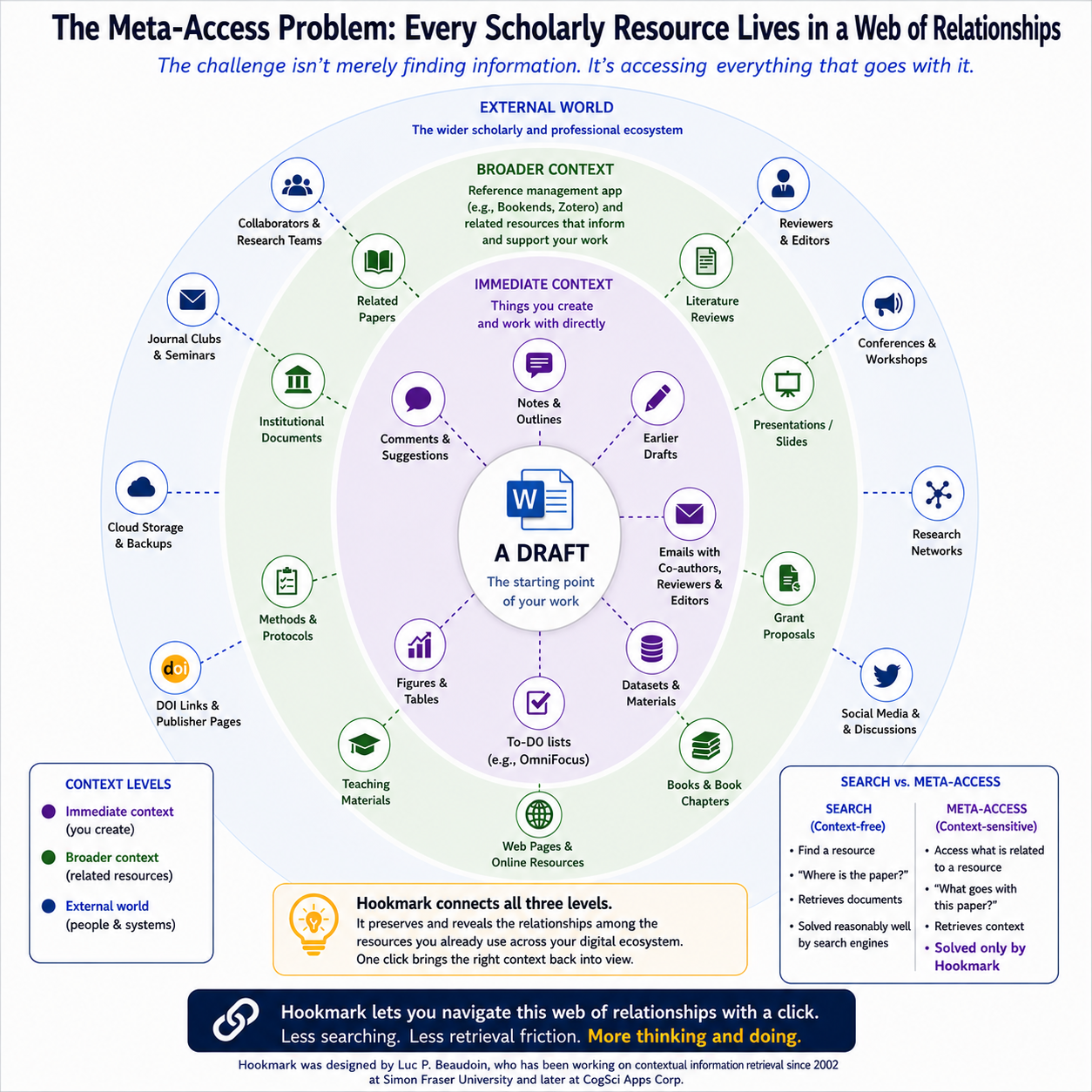
Academic work creates and consumes extraordinary amounts of knowledge. Professors, graduate students, postdoctoral fellows, research assistants, librarians, and clinician-scientists work with papers, notes, drafts, datasets, emails, presentations, grant proposals, course materials, reference records, and project plans. These resources are rarely useful in isolation. Their value often depends on the relationships among them: the manuscript and the reviewer comments, the draft and the co-author’s email, the paper and the bibliography record, the dataset and the figure, the lecture slide and the article it explains.
That is why scholarly work is not merely a matter of storing information. It is a matter of preserving context. A draft is more useful when it remains connected to the reviewer comments, editor decisions, earlier drafts, figures, to-do lists, datasets, and emails that shaped it. A bibliography entry is more useful when it remains connected to the notes, annotated PDFs, manuscripts, and web resources that give it meaning. Hookmark was designed for this kind of work: work in which knowledge lives across many apps, files, and web resources, but still needs to remain connected.
The Meta-Access Problem
Search technology has improved dramatically over the past several decades. Search engines, desktop search, and bibliographic databases make it easier than ever to locate information. Yet locating a resource is often only the beginning. Once you’ve found a paper, draft, email, dataset, or bibliography record, another question immediately arises: what else is related to this?
That question is fundamentally different from ordinary search. Conventional search is largely context-free: you search by title, author, keyword, date, folder, sender, or content. The goal is to find a resource. Meta-access is context-sensitive: starting from one focal resource, such as a manuscript draft, you want to access the surrounding resources that belong with it — notes and outlines, earlier drafts, emails with co-authors, reviewers and editors, reviewer comments, figures and tables, datasets, project folders, to-do lists, grant proposals, reference manager records, and related papers.
In Cognitive Productivity: Using Knowledge to Become Profoundly Effective, CogSci Apps co-founder and Professor Luc P. Beaudoin called this challenge the meta-access problem. It is not primarily a problem of finding information. It is a problem of accessing information that is related to your current task, focus and information resource.
Professors, students, and researchers face the meta-access problem constantly because scholarship is cumulative. A project often unfolds over months or years. A paper you read last semester becomes relevant to a lecture next year. A reviewer comment from a previous submission becomes relevant to a new manuscript. A dataset used in one article becomes the basis for a presentation, a grant proposal, or a student project. The difficulty is not simply remembering that these resources exist. The difficulty is recovering the context that connects them.
Hookmark Reduces Retrieval Friction
Every time you stop writing, reading, teaching, or analyzing data in order to reconstruct context (i.e., to search for related information), your attention shifts away from the intellectual task and toward information management. You remember that a co-author raised a point, but not which email contained it. You remember outlining a response to a reviewer, but not where that note was saved. You remember that a figure came from a particular analysis, but not which folder contains the script or spreadsheet. Each interruption may seem small, but together they create retrieval friction: the unnecessary cognitive and practical effort required to return to the knowledge you already have.
Hookmark reduces retrieval friction by letting you preserve links among the resources you use every day. It does not require you to move your work into one large proprietary bucket. Instead, it connects resources across the apps, files, folders, emails, and web pages that already make up your scholarly environment. Search helps you find a resource. Hookmark helps you access what goes with the resource.
Robust, shareable links to files and emails
Hookmark’s links to files are robust, meaning you can rename and move the files and yet the links still work. What’s more Hookmark’s links to files and to emails can be shared with other people; as long as they also have access to the file (e.g., in Dropbox) or email, the links will work for them!
Your Draft Becomes a Scholarly Hub
The meta-access problem is especially evident in writing documents. A draft accumulates context. It is connected to the papers you cite, the notes you wrote while reading them, the datasets that support the claims, the figures and tables you prepared, the co-author emails that shaped the argument, the reviewer and editor comments that prompted revisions, and the to-do lists that track what remains to be done.
With Hookmark, those relationships can remain directly accessible from the draft itself. While writing, you can connect the draft to emails from co-authors, reviewers and editors, reference manager entries, project folders, figures, datasets, notes, outlines, grant proposals, and task lists in apps such as OmniFocus. Later, when you return to the manuscript, you do not need to reconstruct the project’s history. The context is still there.
Your Bibliography Becomes More Than a Catalogue
Reference management apps such as Bookends and Zotero are excellent at organizing citations. Hookmark extends them into a connected scholarly environment. From a bibliography entry, Hookmark can take you to the annotated PDF, the notes you wrote while reading, the manuscript draft that cites the paper, the grant proposal in which it appears, related datasets, presentation slides, project folders, issue tracker entries, relevant web resources, and emails exchanged with co-authors, reviewers and editors.
Likewise, while viewing any of these resources, you can instantly return to the bibliography record. Your bibliography becomes more than a catalogue of references. It becomes a hub for your scholarly work.
Hookmark can also use identifiers already present in bibliography records. Many records include a DOI or another persistent URL, and Hookmark can display the publication’s home page in its Context window. That makes it easier to access the publisher page, supplementary materials, related online resources, and updates to the publication without manually reconstructing the path from the citation to the scholarly web.
Hookmark can also show you the top papers that cite, and are cited by, the PDF you are viewing!
Reading Becomes Thinking
Reading alone rarely produces lasting understanding. Note-taking does. While reading a paper, you can use Hook to New to create a new note in your preferred note-taking app and automatically bidirectionally link (“hook”) that note to the paper. Months or years later, whether you begin with the note or the paper, the relationship remains intact.
This matters because academic reading is not merely consumption. It is interpretation, evaluation, comparison, questioning, and integration. Hookmark supports this process by making it easy to capture thoughts while they are fresh and preserve the connection between a thought and what prompted it.
Teaching Is Knowledge Work Too
Professors do not stop being scholars when they teach. Lectures grow out of papers, books, examples, diagrams, assignments, and student questions. A syllabus may be connected to readings, lecture slides, grading rubrics, supervision notes, and research projects. A student’s thesis draft may be connected to advisor feedback, reference manager records, datasets, and earlier versions.
Hookmark helps teaching and research remain part of the same connected knowledge environment. You can link lecture slides to the papers they explain, course readings to notes and assignments, supervision notes to thesis drafts, and student projects to the research literature they draw upon. This is especially valuable for academics whose work moves constantly between research, teaching, supervision, service, and administration.
Supporting Epistemic Agency
Educational researchers increasingly emphasize epistemic agency: the capacity to direct one’s own learning, reasoning, inquiry, and knowledge creation. (Autonomous agency was the topic of Luc P. Beaudoin’s Ph.D. thesis; epistemic agency of knowledge workers [not just students] is partly what his Cognitive Productivity books are about.) In practical terms, epistemic agency depends not only on what one knows, but also on how effectively one can shape and use the environment in which knowing takes place.
Hookmark supports epistemic agency (and more generally, meta-effectiveness) by helping scholars intentionally structure their external cognitive environment. Rather than imposing a proprietary knowledge management system, a single knowledge bucket such as Notion or Obsidian, Hookmark lets you preserve meaningful relationships among the apps and resources you already use. You remain in control of your own scholarly ecosystem.
Designed from Cognitive Productivity Research
Hookmark was designed by Dr. Luc P. Beaudoin, who has been working on contextual information retrieval since 2002 at Simon Fraser University and later at CogSci Apps Corp. Its design is informed by the deep cognitive productivity perspective developed in Cognitive Productivity: Using Knowledge to Become Profoundly Effective and Cognitive Productivity with macOS: 7 Principles for Getting Smarter with Knowledge.
Cognitive productivity is not merely about doing more. It is about using information environments that make thinking, learning, remembering, writing, and creating easier. In academic work, that means reducing unnecessary searches, preserving context, maintaining access to related knowledge resources, and supporting sustained attention on the work that matters.
Connecting AI Chats to What They Are About
AI chats should not be isolated from the work that prompted them. They are often about a particular draft, PDF, dataset, email, web page, bibliography entry, or project. If the chat remains disconnected from that focal resource, then it becomes one more item that must later be searched for, remembered, or reconstructed.
Hookmark enables you to skip the search, by linking your AI chats to what they are about. A conversation about a manuscript can be linked to the manuscript. A chat about a PDF can be linked to the PDF. A discussion of reviewer comments can be linked to the review, the response letter, and the revised draft. This means you can navigate instantly to and from your AI chats, preserving them as part of the same scholarly context as the rest of your work.
A Different Philosophy of Knowledge Work
Much of today’s productivity software is designed around storing information. Hookmark is designed around preserving relationships between resources and retrieving related information. That difference reflects a broader philosophy.
Some apps —such as Notion, Capacities, Obsidian, and Roam Research —let you connect information within them, but those are walled gardens. They allow you to bidirectionally link within the garden but not to information in other apps. Hookmark bidirectionally connects information within and between your apps. It lets you keep using the tools you already prefer — your reference manager, PDF reader, note-taking app, email client, browser, task manager, file system, and AI chat system — while preserving meaningful relationships across them.
Knowledge does not live only in documents, databases, or apps. It lives in the meaningful relationships among resources, practices, people, and projects. Academic work depends on these relationships, but most software leaves them fragile, implicit, or trapped inside particular apps. Hookmark makes them explicit, durable, and navigable.
Spend Less Time Reconstructing Context
Whether you are a professor, graduate student, postdoctoral fellow, research assistant, librarian, clinician-scientist, or research professional, Hookmark helps you spend less time reconstructing context and more time thinking and doing.
Scholarship is not simply about finding information.
It is about accessing what goes with it.
Discount for academics
Academics receive 25% off the regular price of Hookmark on our educational store.
for more information
- Download Hookmark for Mac
- Watch these videos
- Check out Hookmark Help pages
- read Using Hookmark with Bookends Reference Manager by Sonny Software
- Join the discussions on the Hookmark forum.