
Hookmark has a much longer history than most people realize.
Its origins go back well before the first public beta, which we released on January 24, 2014—exactly 30 years after Apple’s famous “1984” Macintosh commercial.
Years earlier, while leading the development of gStudy at Simon Fraser University as part of the Learning Kit project, I proposed that every object in the application should be linkable to every other object. Over time I realized that this idea shouldn’t be confined to a single application. What we really needed was software that could connect information across applications: documents, notes, emails, web pages, tasks, calendar events, AI chats, and much more.
That insight eventually became Hookmark.
More recently, AI has made the need even more apparent. Every serious project now accumulates a growing ecosystem of PDFs, notes, AI conversations, emails, meeting transcripts, drafts, datasets, issue tracker entries, and other resources. Finding one of them is usually easy. Remembering—and navigating—their relationships is much harder.
In my book Cognitive Productivity: Using Knowledge to Become Profoundly Effective, I called this the meta-access problem: the challenge of quickly retrieving the information that matters because of what you’re currently working on.
Hookmark was built to solve that problem.
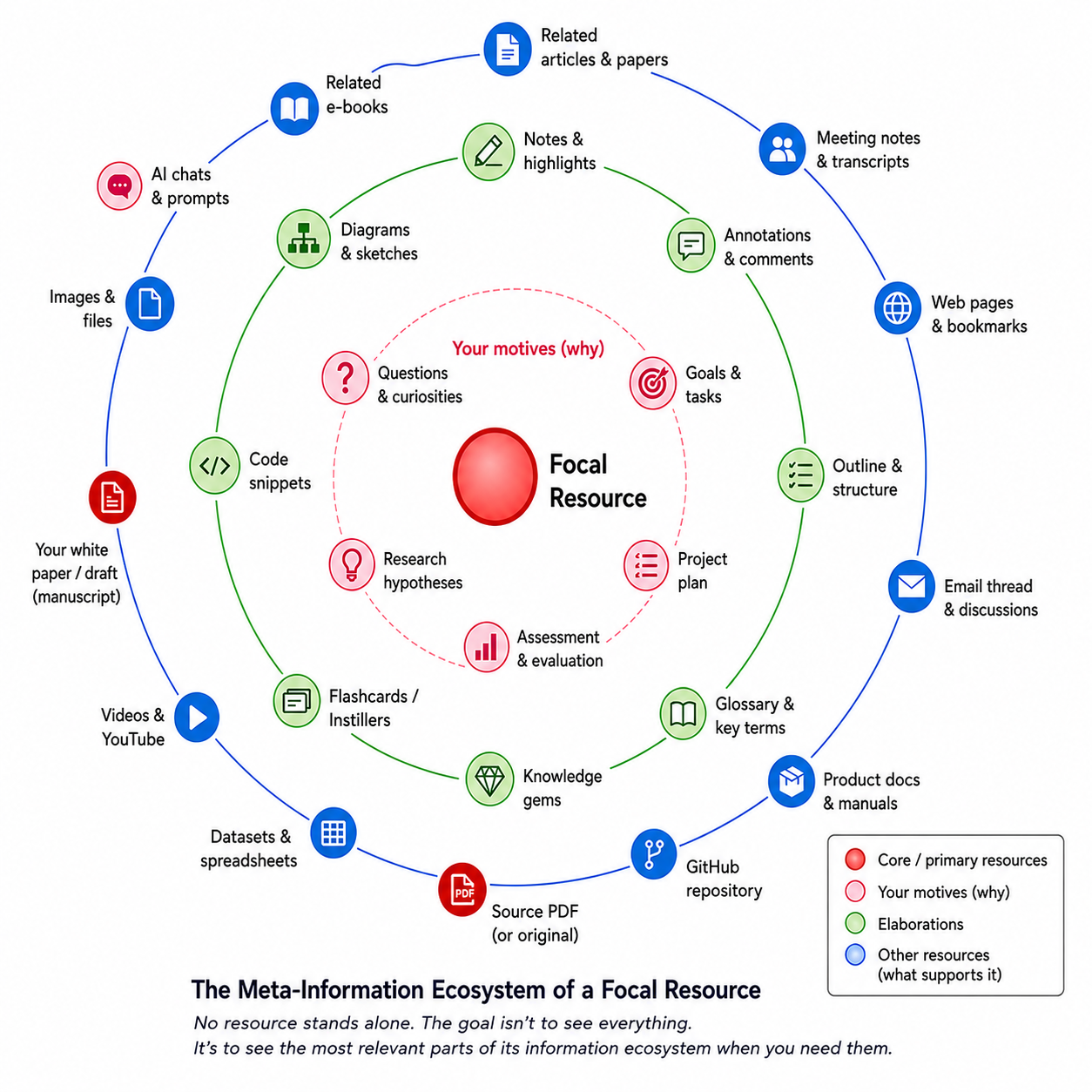
I recently wrote a much more detailed article introducing the concepts of meta-access, contextual information retrieval, and information ecosystems, and explaining why I believe these ideas have become even more important in the age of AI.
→ Read the full article on Substack: Contextual Information Retrieval in the Age of AI